
January 18, 2026
#Development
#Budgie Control Center
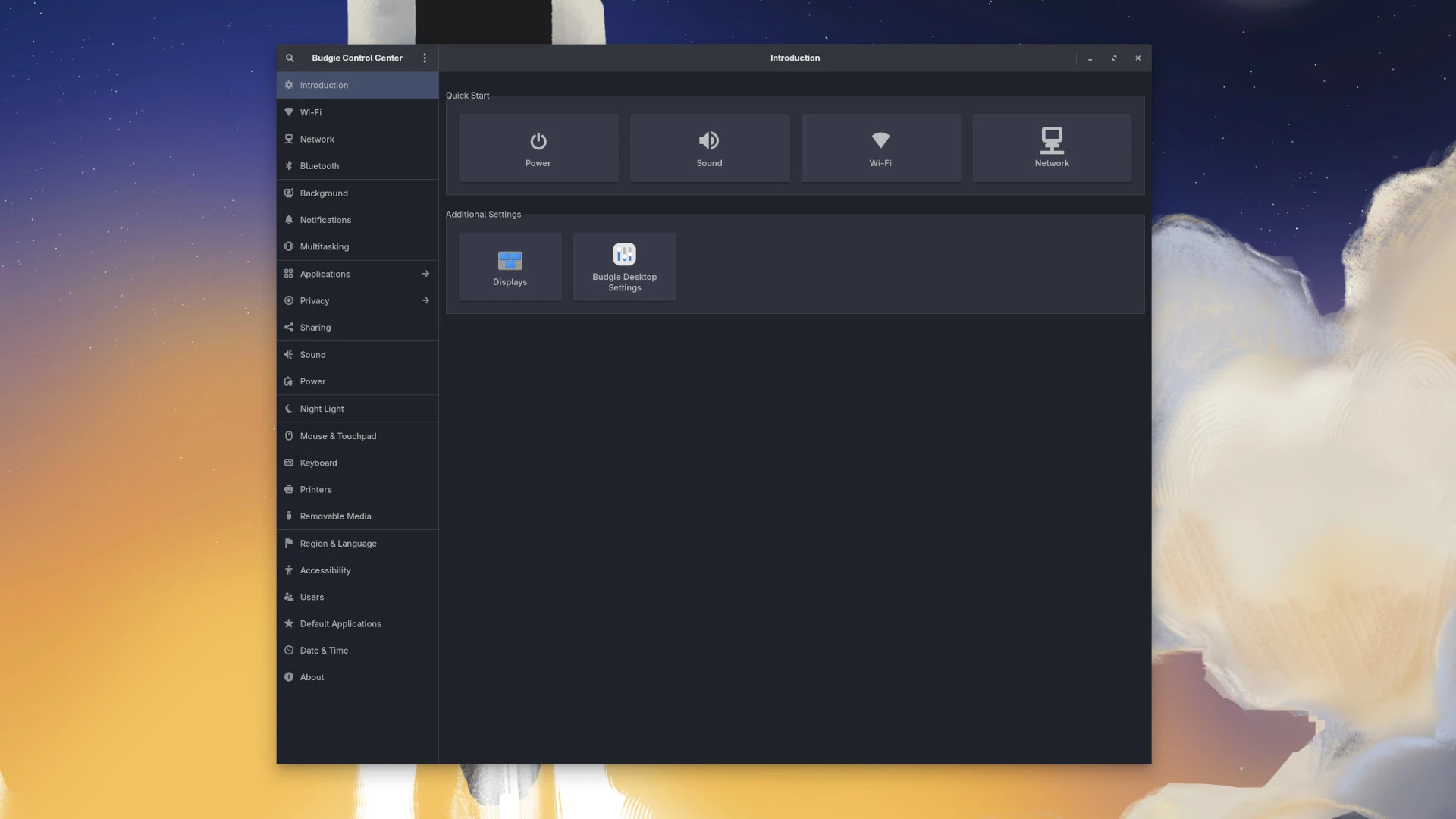
This week, we included an Introduction panel into the existing 10-series Budgie Control Center. This section provides a distribution-configurable panel with access to various quick settings and additional settings utilities. Since display configuration moved out of Budgie Control Center for Budgie 10.10, ensuring users have a clear and approachable way of launching display settings from the same Settings app they are familiar with is important. Internally, the team discussed how that would end up working in practice (for example, whether the old "Displays" panel would just have a button to launchwdisplays), however in the end David came up with this more flexible solution.
By default, this section will have a Quick Start to go to panels for Power, Sound, Wi-Fi, and Networking.
For additional settings, we provide an easy way of firing up wdisplays (as that is the preferred graphical display configurator for Budgie 10.10) and Budgie Desktop Settings. Once this is landed in a Budgie Control Center release, it'll ship in Fedora with an "Additional Settings" item for launching Bluejay for Bluetooth management.
#Budgie Desktop Services
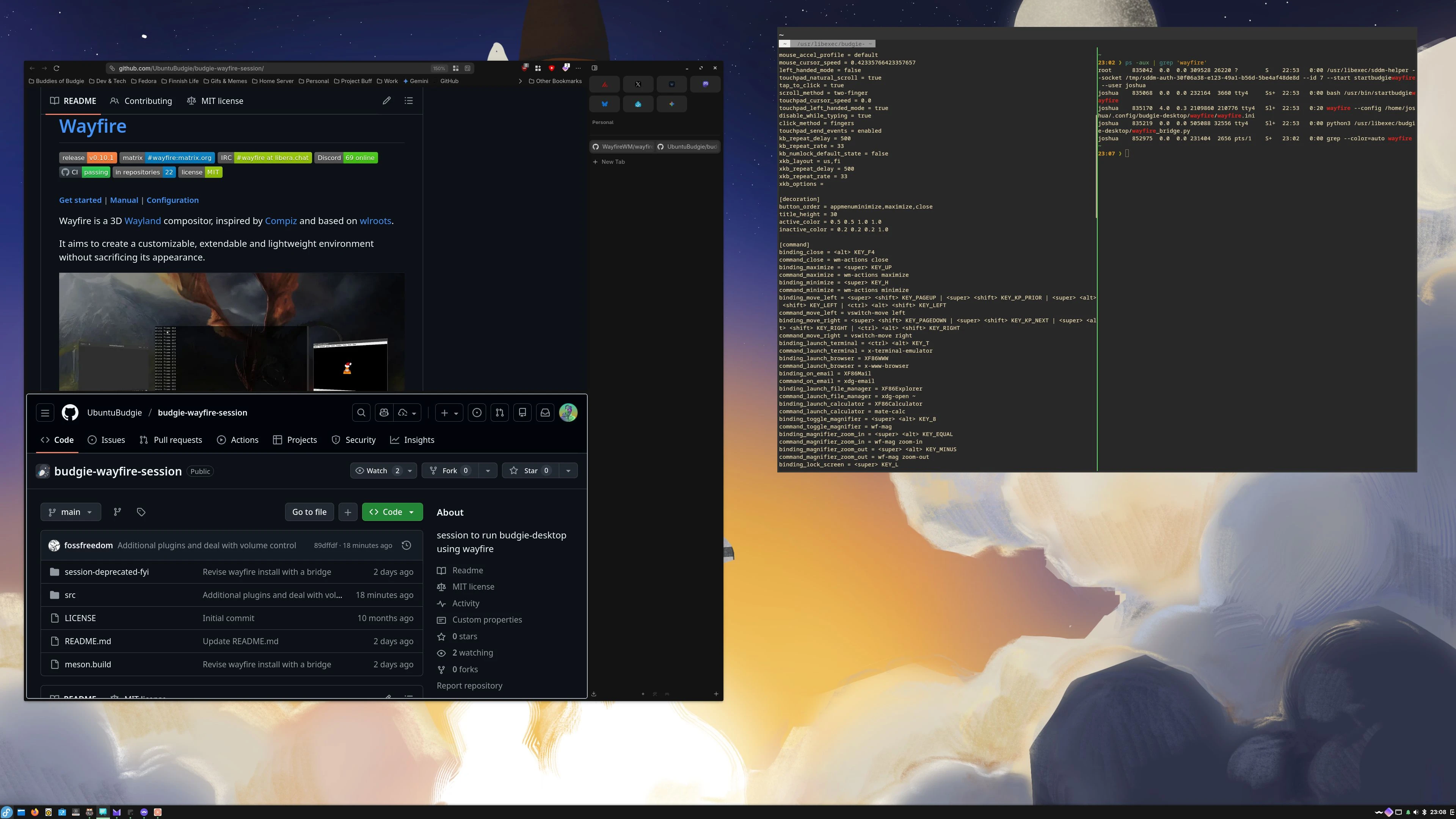
A couple of patch releases of Budgie Desktop Services were released this week.autostart file by default, as we had since implemented a solution for launching the service via our launch script in budgie-desktop. We are going to continue to monitor how Services behaves during compositor restarts / crashes, rather than rely on compositor-specific hooks, and make sure to address any issues that arise related to use of the wayland socket should any occur.#Budgie Desktop (10.10)
A couple notable items have landed inbudgie-desktop since its release last week:
greetdswaybg calls set to fill to avoid backgrounds getting skewed if they have a different aspect ratio than the respective output (display). Now, we will check the preferred placement mode / "style" defined from GnomeBG, mapping various "styles" to swaybg modes. We have made this configurable via the Background panel of Budgie Control Center.
Regarding the second item, greetd does not start Budgie Desktop from the desktop file, which leads it to set a dummy XDG_CURRENT_DESKTOP. At launch, we will now check if XDG_CURRENT_DESKTOP doesn't contain Budgie and force the value if it is missing.
These updates will land in a minor 10.10.1 release. However, given how new Budgie 10.10 is, we will let it cook a bit to provide time for feedback and address any issues before we tag another release!
#Budgie Desktop View
While Budgie Desktop View does not yet support arbitrary positioning of contents of your Desktop folder (that'll come when we port it to Qt6), support has just landed for being able to manually sort entries on the current Flowbox, as an alternative to the alphabetical sorting. You can expect this to land in next minor release of Budgie Desktop View.#Website
The Buddies of Budgie website has now moved off GitHub. Previously, our Vercel deployment flow leveraged the Vercel GitHub app, however with the move we are now using Vercel's deployment tooling via its CLI through a Woodpecker CI workflow. One less repo on GitHub! Alongside this, I have spent time this week updating the site (locally) to finally using Nextjs's App Router and moving it from using MUI to Tailwind CSS + shadcn/ui. This will lay the groundwork for a subsequent redesign planned as part of an effort to better communicate: current Budgie, future Budgie (11), the organization, development, and more. Hopefully will get that groundwork rolled out by next weekend :)#Budgie 11
This week as part of our planning phase for Budgie 11, we have come to the following decisions related to what libraries we want to use, internal plumbing, and bootstrapping a couple Budgie 11 repositories.#Configuration
For context, we currently leverage toml11 for serialization and deserializing of our display configuration in Budgie Desktop Services. While the library is great and the TOML format is preferred for "user-facing" files, the current implementation results in a few pain-points:KConfigWatcher, our goal is to enable configuration-driven panel changes.#Panels and Raven
In Budgie 10.10, Raven is architected as a completely separate window that consumes one side of an output. Although the panels already handle their own GtkLayerShell calls and window state, Raven was not originally conceived as a panel. This conceptual separation prevented shared code reuse, requiring Raven to maintain its own independent implementation. This is being rectified in Budgie 11 by ensuring Raven sub-classes the Panel (or a similar shared class between the two). This architectural shift provides several key advantages:#budgie-shell repo
We have established the budgie-shell repository to serve as the central hub for core shell components. At this stage of development, we have agreed that the repository will manage the following responsibilities: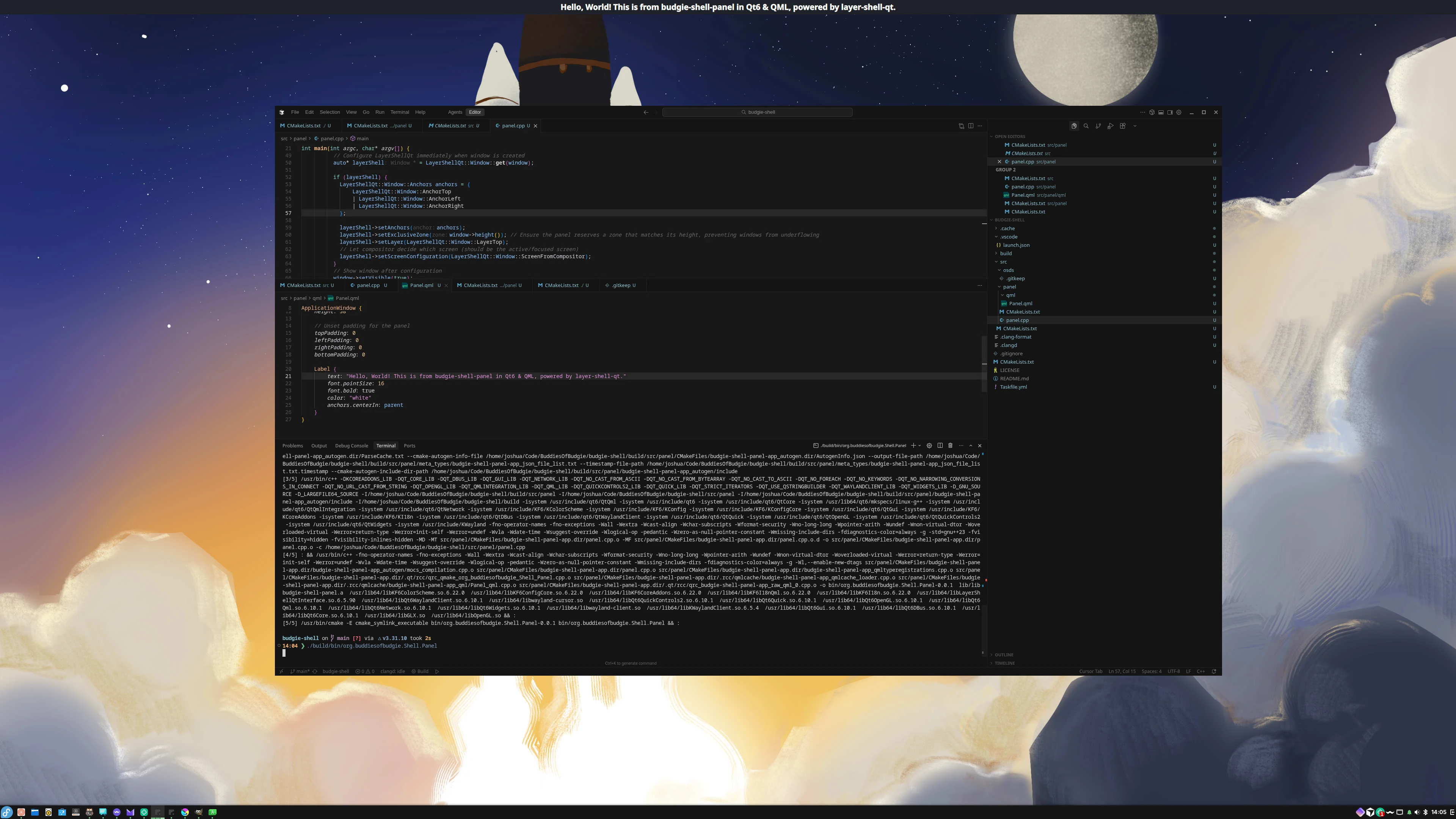
#magpie repo
We have also initiated a new repository for magpie. This iteration will be using Mir / miral. The Mir team has done a fantastic job at documenting the project and providing clear on-ramps for developers, enabling a clearer pathway to building compositors. Most importantly for our needs, Mir provides a native C++ API that aligns well with our development goals for Budgie 11. So expect some actual code (and screenshots) to be shared in the coming weeks!Did you know that you can financially support the Buddies of Budgie project? Buddies of Budgie was founded to provide a home for Budgie Desktop and your financial contribution can go a long way to supporting our goals for development, providing opportunities for financial compensation, leveraging no-compromise Continuous Integration and Continuous Delivery systems for Budgie 11 development, and more.