
January 10, 2026
#Waylandifying Budgie Desktop
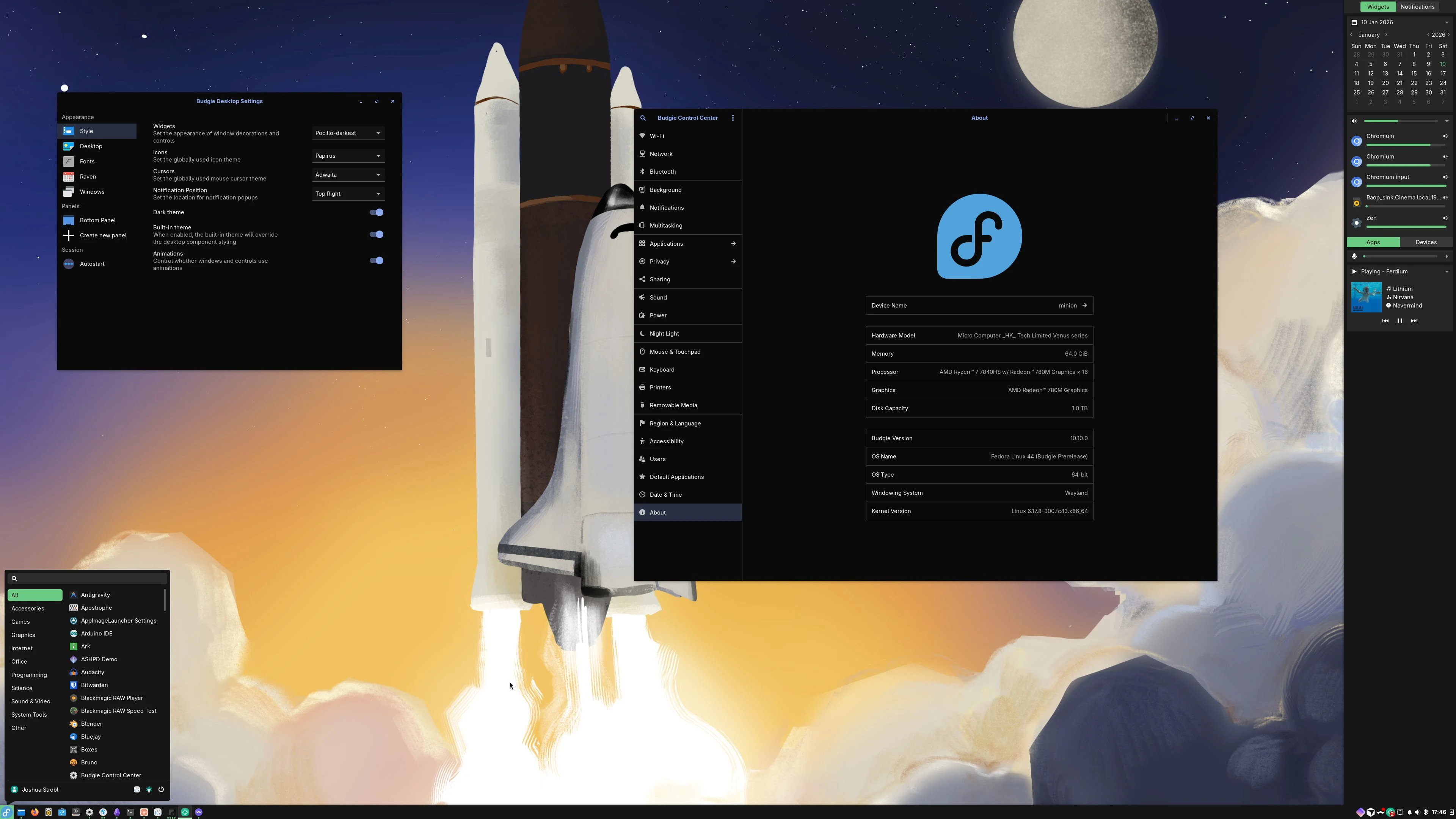
Fundamentally, the experience of using Budgie Desktop under Wayland remains the same as it was under X11. You still have your applets, panels, and Raven, along with desktop icons provided by Budgie Desktop View. Your keyboard shortcuts remain familiar. The team has put extensive effort into ensuring that the transition to Wayland is as seamless as possible for end users.#Leveraging the Wayland Ecosystem
At its core, the goal of Budgie 10.10 is to offer a similar, if not better, experience than what users expect from Budgie Desktop under X11. Rather than reinventing the wheel, we focused on integrating well-established and well-loved Wayland tools to create a more cohesive experience. These tools enable us to seamlessly implement a wide array of functionality:ext-session-lock protocol, and Budgie Screensaver (our fork of gnome-screensaver) is now considered deprecated. Your screen will automatically dim and lock after inactivity, and manual locking is supported at any time.#Compositor Recommendation and Bridge
For Budgie 10.10, we recommend the use of a wlroots-based compositor. The team has put special effort into enabling a great experience with labwc, a modern, lightweight, and feature-rich Wayland compositor perfectly suited for Budgie Desktop. We have achieved this by implementing a "labwc bridge" that automatically configures labwc with (in our opinion) sensible defaults. It mirrors settings from Budgie Control Center and Budgie Desktop Settings to labwc-specific configuration files in~/.config/budgie-desktop/labwc (while also supporting XDG_CONFIG_HOME). This bridge enables:
labwc, the move to Wayland represents a fundamental architectural shift. This shift to a protocol-first architecture represents a major milestone: it decouples the desktop from a specific window manager (budgie-wm, which in turn relied on our fork of Mutter called Magpie), and makes Budgie truly compositor-agnostic, opening the door for experimentation with alternative compositors beyond our primary recommendations.
To support this flexibility, Budgie 10.10 relies on several Wayland protocols across its use of budgie-desktop-services, gtk-layer-shell and libxfce4windowing. While other compositors remain less tested by the team, any compositor implementing the following protocols could, in principle, power a Budgie session:
#Applet Updates
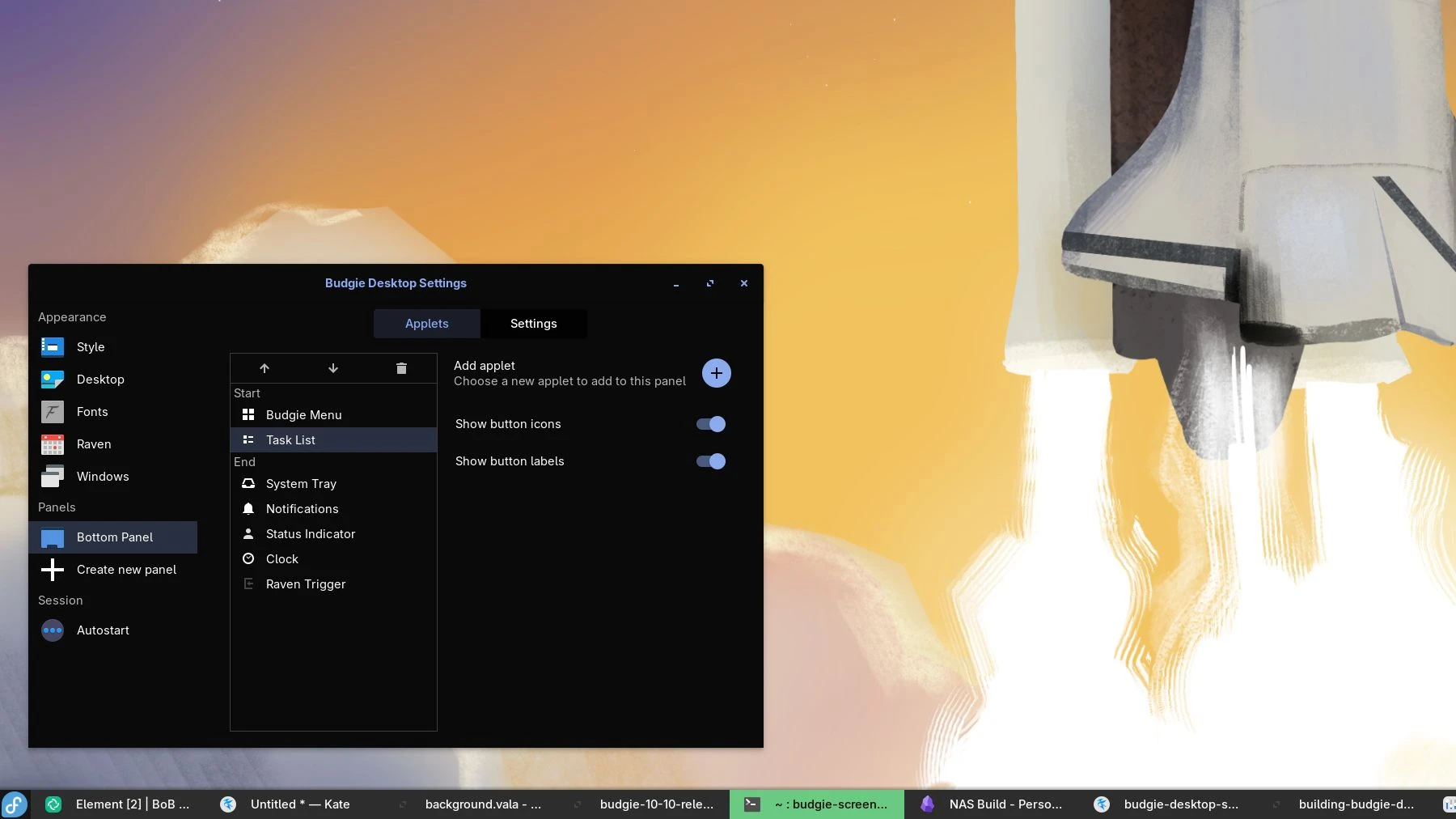
Wnck Tasklist to a more modern implementation that is built on top of libxfce4windowing. The new Tasklist scales better with many applications, including dynamic button sizing and dynamic scrolling (left and right navigation buttons also appear for more ease-of-use).#Panel Updates and Improvements
budgie-panel now leverages layer-shell to anchor itself to the screen edges. We also improved the logic for start, center, and end sections to dynamically calculate heights / widths (depending on orientation), ensuring inner applets like the legacy Tasklist trigger overflow behavior correctly.
#Other Component Updates
Ourbudgie-desktop was not the only component that received updates to enable Wayland support!
#Budgie Desktop View
Budgie Desktop View now supports Wayland, leveraginglayer-shell to ensure it remains positioned behind windows, Raven, and the panel.
#Budgie Control Center
A new version of Budgie Control Center ships with this release, featuring several changes:gnome-bluetooth libraries. We recommend distributions ship Bluejay.#Budgie Session
Budgie Session now includes a Wayland compositor check executable to test if a compositor is started before firing off parts of our session.#Distribution Availability
Budgie 10.10 will ship in the upcoming releases of Fedora (Fedora 44) and Ubuntu Budgie (Ubuntu 26.04). It will gradually become available in other distributions as packagers adopt the new release.#Farewell, Budgie 10
Budgie 10.10 marks the final major release for the 10.x series as we transition it into maintenance mode. While our primary development focus shifts toward the future with Budgie 11, you can count on us to provide continued bug fixes and refined Wayland support for Budgie 10 as we develop the next generation. After more than a decade of development, we are ready to build the future of the Budgie Desktop. We would love for you to follow along—stay tuned for regular updates on our social channels and Matrix space as we bring Budgie 11 to life. Special thanks to everyone who has contributed to making this monumental release possible, and to those who have dedicated time and effort to Budgie Desktop over the years. We couldn't be more delighted to not only close this chapter of Budgie's history but to start writing the next one together.Did you know that you can financially support the Buddies of Budgie project? Buddies of Budgie was founded to provide a home for Budgie Desktop and your financial contribution can go a long way to supporting our goals for development, providing opportunities for financial compensation, leveraging no-compromise Continuous Integration and Continuous Delivery systems for Budgie 11 development, and more.